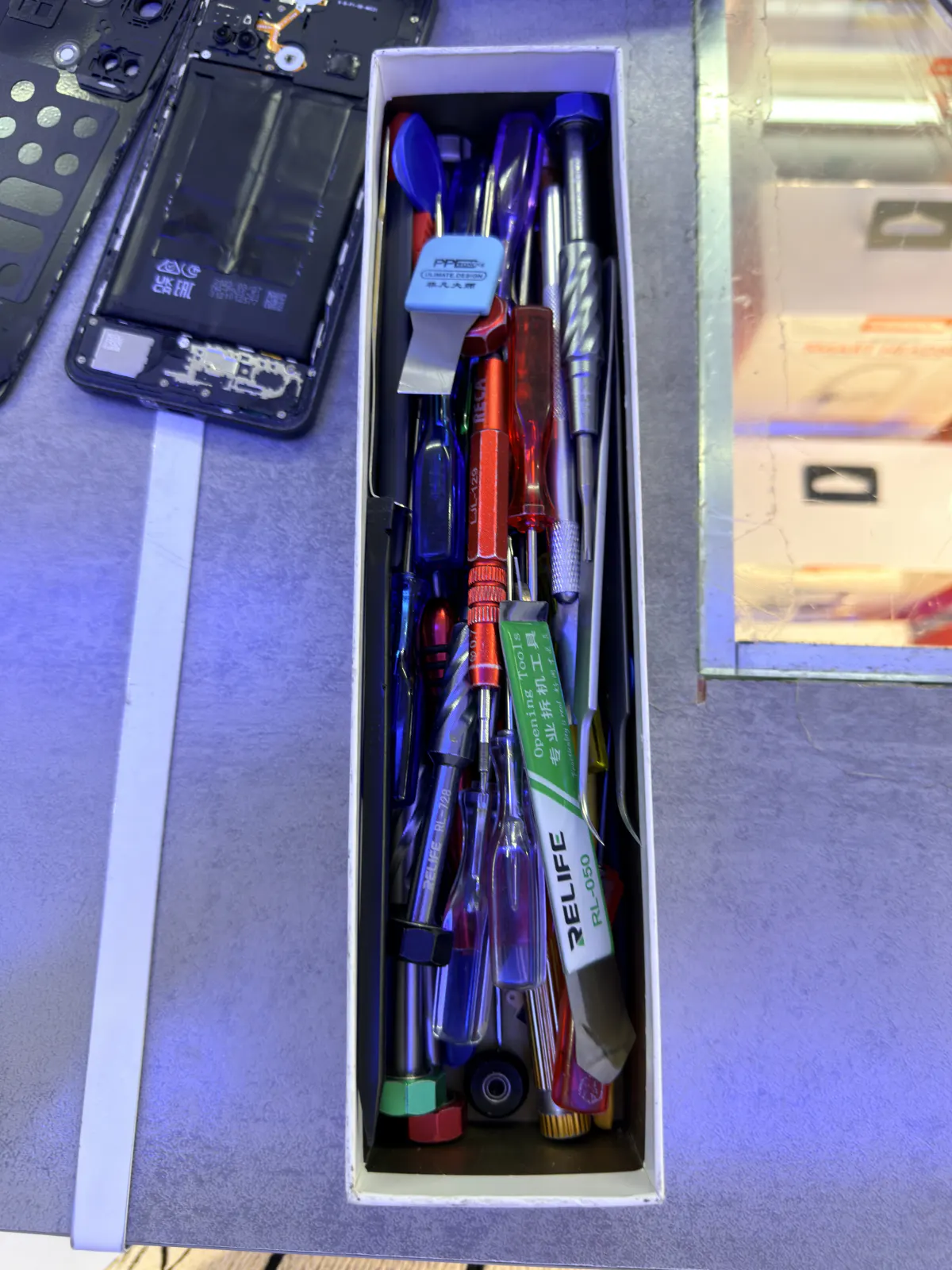
A client once asked me why I was hauling in a toolbox as thick as a dictionary just to swap an iPhone screen. The answer fits in one sentence: on a recent phone, the right precision screwdriver, the right suction cup and a bit of patience are what separate a screen closed up cleanly in forty minutes from a cracked back panel you now have to tell the customer needs replacing too. Here's the unfiltered list of the physical and software tools I actually use on jobs across Paris — what's really sitting in my RELIFE case and on my USB stick, not a generic blog checklist.
A precision toolkit, not a hardware-store box

That's part of my RELIFE screwdriver set, the one I open first on nearly every phone or tablet job. Every manufacturer uses its own screw heads to discourage people from opening their own devices: Pentalobe and Y000 on Apple gear, Torx T3 to T6 on Samsung or Huawei, plain Phillips on most laptops. I once took over a job where a client's iPhone had already been opened elsewhere with a mismatched Phillips driver — both Pentalobe screws on the Lightning connector were stripped smooth, impossible to remove without a screw extractor. The wrong tool doesn't save time; it just doubles the work for whoever has to fix the repair afterwards.
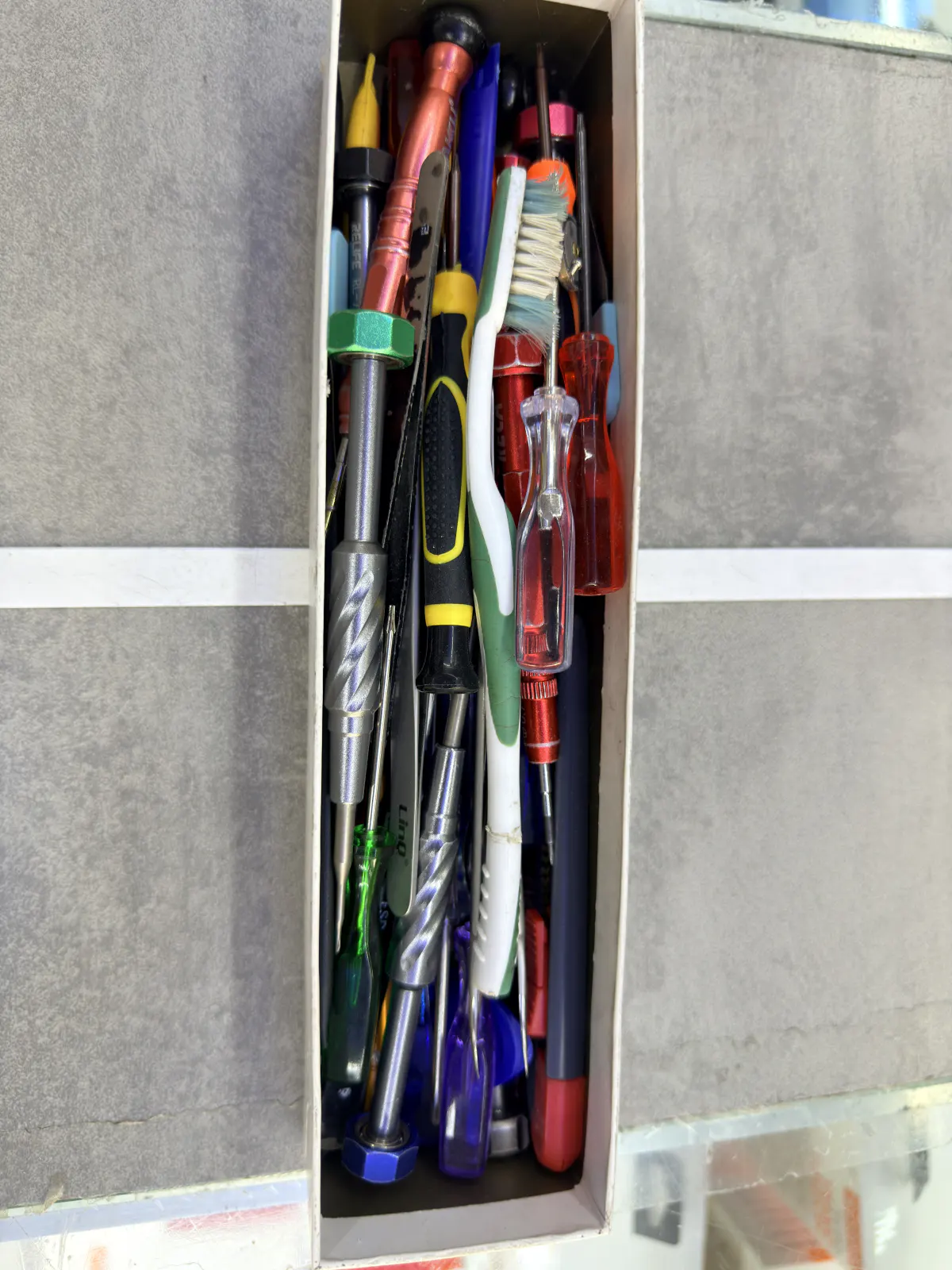
Next to the screwdrivers sit the plastic and metal spudgers, fine-nose pliers, an anti-static brush for cleaning an oxidised connector, and a handful of guitar picks that double as non-conductive levers for lifting a frame without scratching the housing. All of it lives on an anti-static, magnetic mat: the screws on an iPhone 15 are barely two millimetres long, and a mat that holds onto metal parts stops the camera-hinge screw rolling off the bench and under a cabinet — that happened to me exactly once, never twice.
Opening a screen without cracking it: suction cups and spudgers
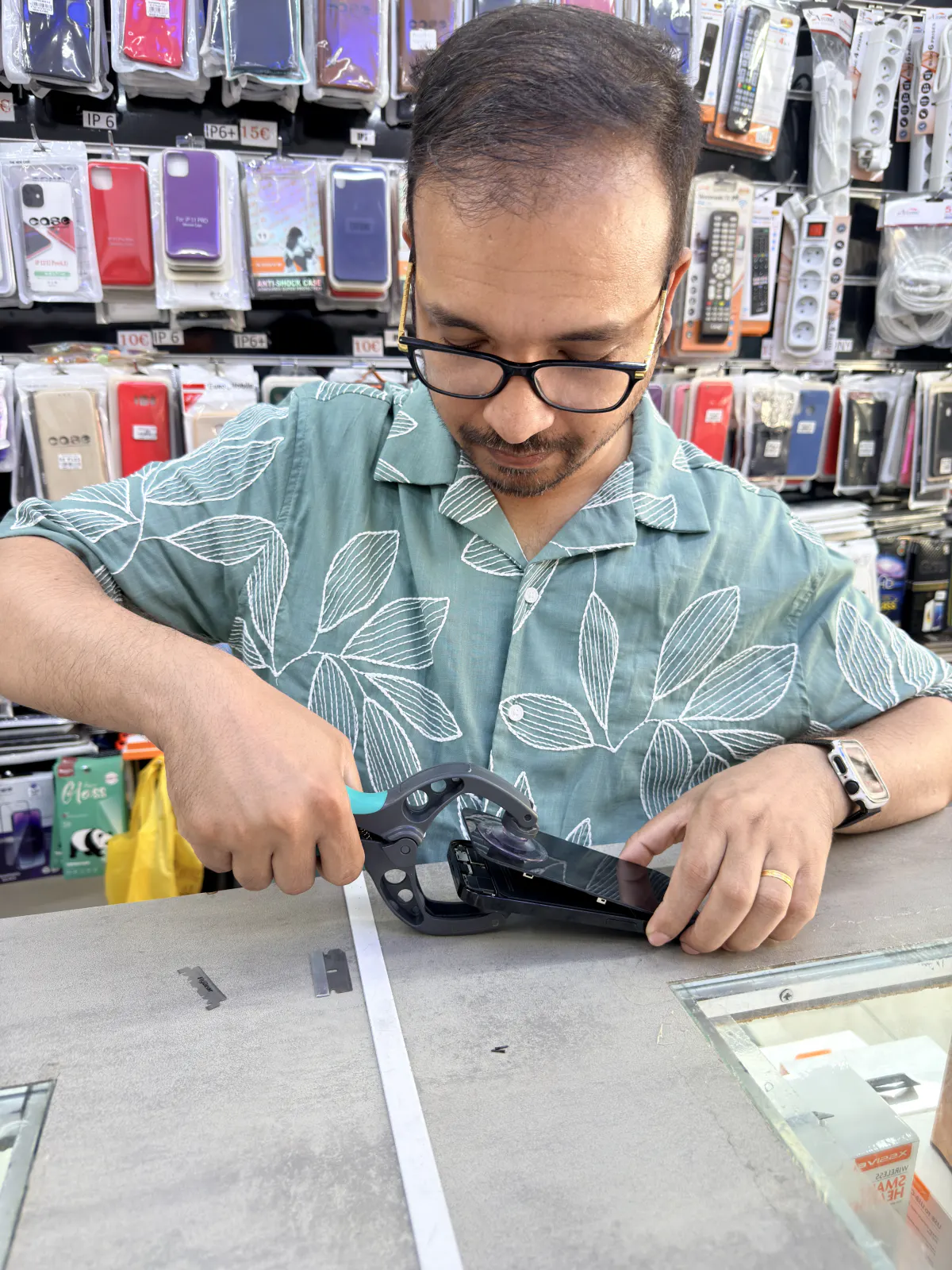
Opening a screen that's already broken is the easy part — the glass is gone, so you can be reasonably direct about it. Opening a screen that still works, to swap a battery or a charging port, is where the double-suction plier tool earns its place. In this photo I'm lifting the frame off a phone with an intact display; the plier spreads the pulling force across two points instead of one, which cuts the risk of cracking the panel the moment the factory adhesive lets go all at once. A single suction cup on an already-cracked screen, by contrast, barely holds — the seal breaks along the crack lines instead of gripping the glass.
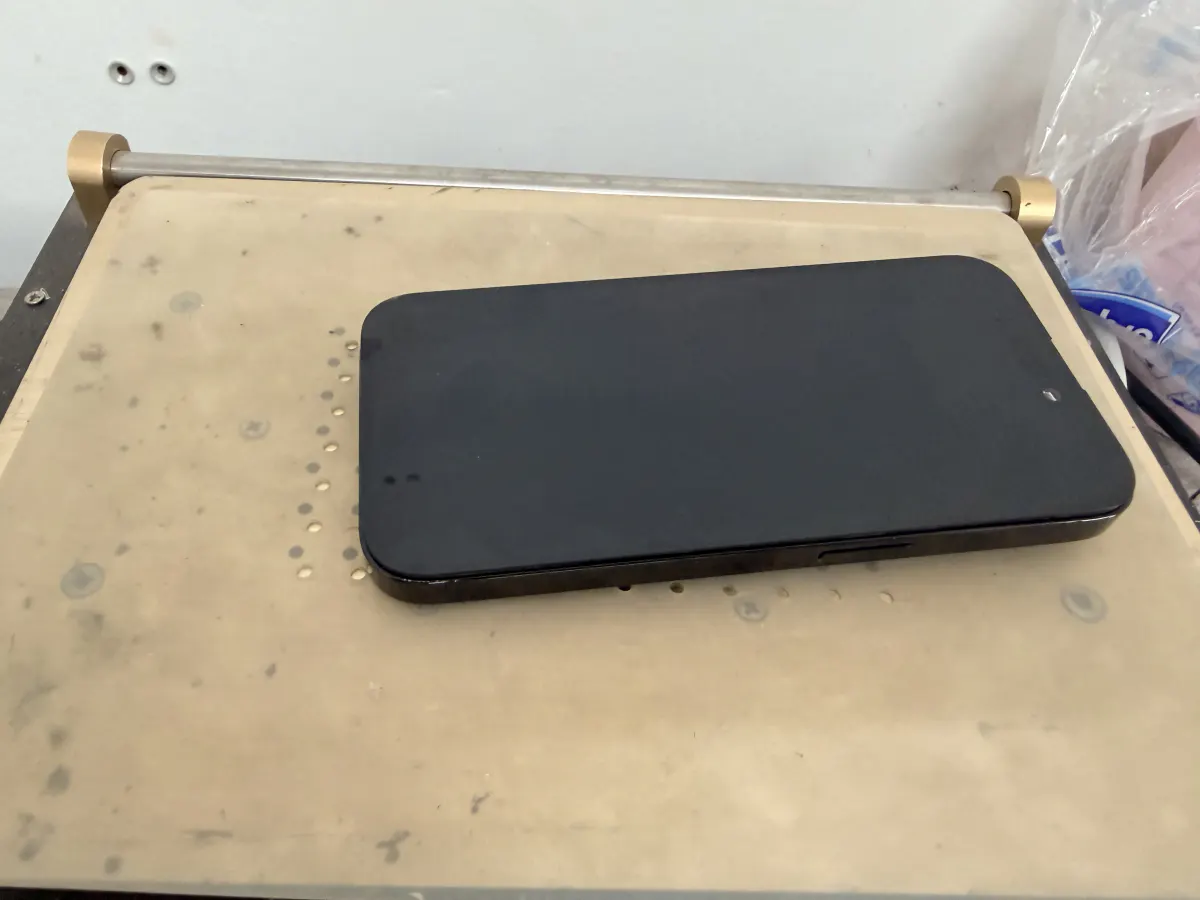
Before the suction cup even comes out, the device often sits on a low-temperature heating plate long enough to soften the factory adhesive without cooking the lithium battery right underneath — past a certain temperature that battery swells, and a swollen battery is an emergency, not a footnote. One client who came in for a plain screen swap turned out to have exactly that: a swollen battery under an otherwise intact display. Without that visual check during opening, the phone would have left the shop with a defect nobody could see from outside. For iPhone jobs like this, I've laid out real pricing on my iPhone battery replacement in Paris page, since battery and screen work often get booked together.
Diagnostic gear: a display tester and a charging-port tester
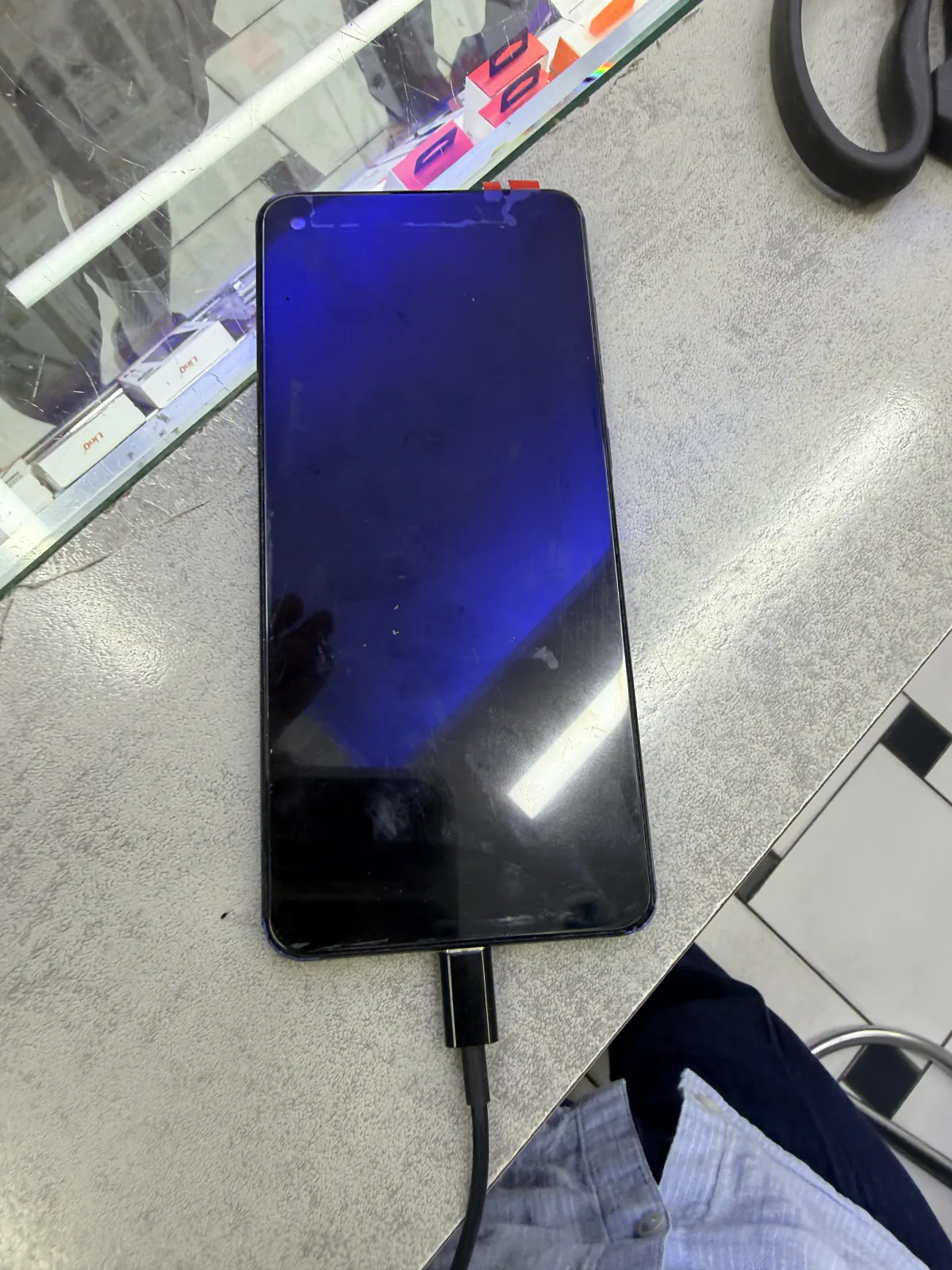
That blue panel isn't screwed into a phone yet — it's being powered by a test cable so I can check for dead pixels, banding or discolouration before final reassembly. Closing a phone up, finding a fault in the new part, then having to reopen everything costs an hour and stresses the adhesive a little more each time it's disturbed. This tester costs around thirty euros and pays for itself the first time it catches a bad part before installation. The same logic applies to the charging-port tester: a client near Auteuil was convinced his iPhone's Lightning connector was broken and ready to pay for a port repair; the test showed a perfectly working port — the real culprit was a frayed cable he'd been using for months. I'd rather spend five minutes testing than bill for a part that didn't need replacing, which is the same principle behind the numbers on my iPhone repair pricing guide: you only replace what's actually faulty.
The software toolkit: bootable USB, diagnostics, rescue antivirus
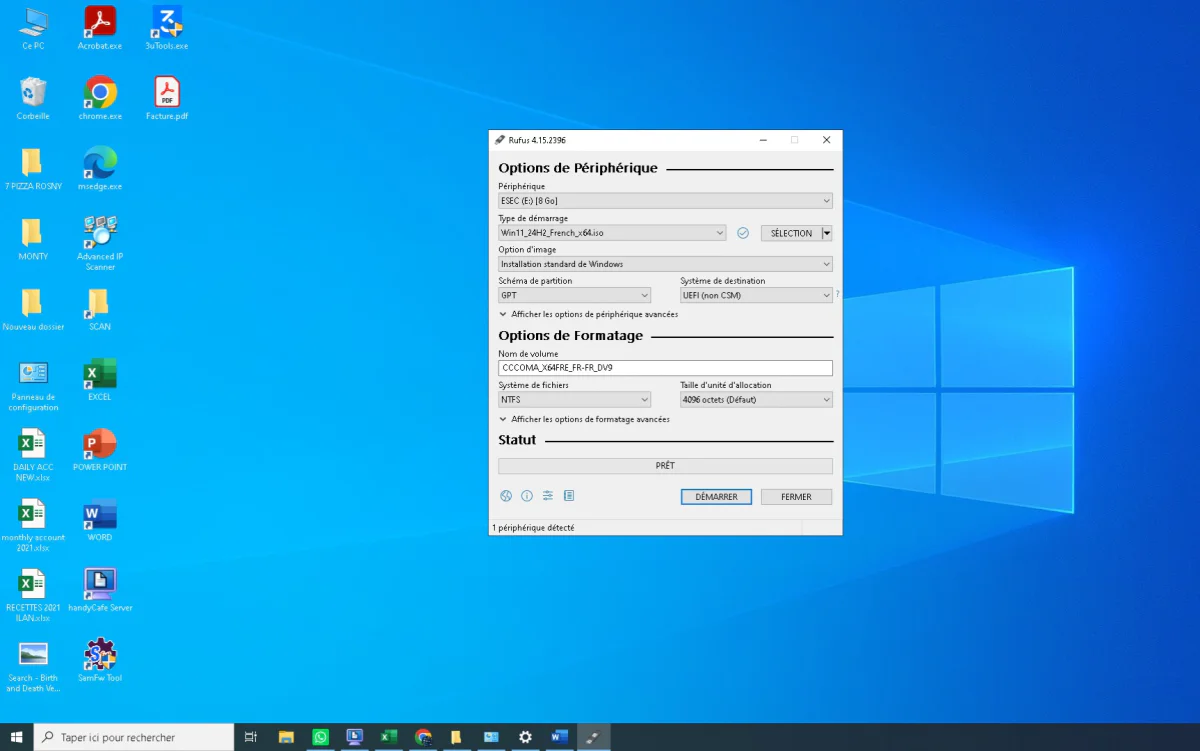
On the software side, the tool I open most often is Rufus. This screenshot shows an 8 GB drive receiving a French Windows 11 24H2 image, GPT partition scheme, targeted at UEFI boot — the kind of detail that looks trivial until a badly formatted drive refuses to boot on a newer machine. Once it's built, that USB drive becomes a small, self-contained Windows environment: it can back up the documents from a PC that won't start, repair the boot sector without a full reinstall, or run an offline rescue antivirus scan when the infection itself is what's stopping Windows Defender from launching normally. I used this exact drive on a home visit near La Muette: the client's PC was stuck in a blue-screen loop, so we copied his family photos to an external drive from the rescue environment first, then repaired the boot — in that order, never the other way round. For work like this at a client's home rather than in the shop, my home IT support in Paris page explains how the visit runs. On phones, a tool like 3uTools rounds things out — battery diagnostics, checking whether a second-hand part is genuine, and backups before any work starts.
Why I show my tools
I have no reason to hide what's in the case. A client who sees the difference between a single suction cup and a double-suction plier understands why I sometimes refuse to force an opening that another shop would push through in five minutes flat. Being open about method goes hand in hand with being open about timing: I break down the real turnaround for MacBook repairs in my article on MacBook repair prices and timelines in Paris, because the best tools in the world don't matter if the schedule you quote a client doesn't match what actually happens on the bench.
Frequently asked questions about IT technician tools
Why does a technician need so many different screwdrivers?
Because every manufacturer uses its own screw heads to discourage disassembly: Pentalobe and Y000 on Apple devices, Torx T3 to T6 on Samsung or Huawei, standard Phillips on PCs. The wrong screwdriver strips the head and turns a 20-minute repair into a seized-screw problem.
Can a suction cup damage a phone screen?
A suction cup placed correctly on an intact section of the display does not damage it. The risk comes from using one on an already-cracked screen, or pulling too hard before the adhesive has been warmed, which can shatter the glass instead of releasing the frame.
What is a display tester and why does it matter?
It's a cable that powers a replacement display outside the phone so you can check for dead pixels, discolouration or banding before closing the device back up. It saves reopening an already-reassembled phone if the part turns out to be faulty.
Why use a bootable USB drive instead of reinstalling Windows directly?
When Windows won't start, there is no installer available from the disk itself anymore. A USB drive created with Rufus carries a self-contained environment that lets you back up files, repair the boot sector or reinstall the system without depending on the broken machine.