
"How soon can you come?" It's the second question I get, right after the description of the problem. And the honest answer is rarely a single number. It depends on which part of Paris you're in, what time you're calling, what exactly is wrong with the machine, and whether the part it needs is already in my bag or has to be ordered. A site promising "guaranteed 1-hour response, 7 days a week" is either lying or running a ten-person team with a van full of spare parts — which isn't me, and isn't any genuinely independent technician in Paris. Here are the real timeframes I actually give on the phone, and the reasons behind each one.

What actually determines the timeframe
Three factors matter more than anything else, and none of them are fully within my control. First, the arrondissement and the real travel time: I'm based in the 16th, so an appointment in Passy or Auteuil is a fifteen-minute trip, while a visit to the 20th or out to Vincennes can take forty-five minutes off-peak — and easily double that on a Friday at 6pm with the ring road jammed. Second, traffic and scheduling knock-on effects: an 11am slot can slip if the previous client's issue ran longer than expected, or a métro line has a disruption on a day I'm relying on transit for a well-served area. Third, and often the most decisive factor, is whether the part I need — screen, battery, connector, drive — is already in stock or has to be ordered from a supplier. That third point alone can turn a two-hour job into a job that takes several days, and I usually can't tell which until I've seen the device, or at least a clear photo of it.
Typical timeframes by job type
Here are the ranges I actually quote, not rounded figures meant to sound reassuring.
Remote diagnosis: under an hour, often 20-30 minutes
For a software problem — slowness, an error message, a crashing app, a configuration question — I can usually connect for a remote support session within the hour after your message, often faster during the day. It's the most reliable timeframe in this article because it doesn't depend on traffic or a part being in stock.
Simple on-site visit: same day or next day
A setup job, an on-site virus clean-up, a Wi-Fi network to configure, a printer to connect: if you call in the morning and there's room in that day's schedule, I can come by the same afternoon. If the day is booked, it's the next morning. This is the most common range for a standard home IT visit, and it's the default I give on the phone when nothing more specific has been established yet.
Screen or battery with the part in stock: 1-2 hours on the bench
For models I repair often — recent MacBook Air/Pro generations, iPhone 13 through 16 — I keep certain common parts in stock. In that case the replacement itself takes 1 to 2 hours once the device is in my hands, not counting travel. The full breakdown of prices and timeframes by model is in my Paris computer repair prices article.
Part to order: 2 to 5 business days
A less common model, a motherboard replacement, a proprietary charging connector: if the part isn't already on hand, it has to be ordered from a Paris-based or European supplier. Expect 2 to 5 business days depending on availability — sometimes less if a supplier in the 11th has it in stock and I can collect it the same day, sometimes more if the part is shipping from outside France.
Data recovery: longer, and unpredictable by nature
This is the one category where I deliberately won't give a day count before seeing the drive. A hard drive with failing sectors that still responds can sometimes be handled in an evening. A drive making a mechanical clicking noise needs completely different handling, sometimes a send-off to a specialist lab, and then we're talking weeks, not days. I walk through the full logic in my hard drive data recovery guide for Paris — the key point is to stop using the drive at the first symptom, since that alone changes the odds of a successful recovery.
Why I give a range, not a promise
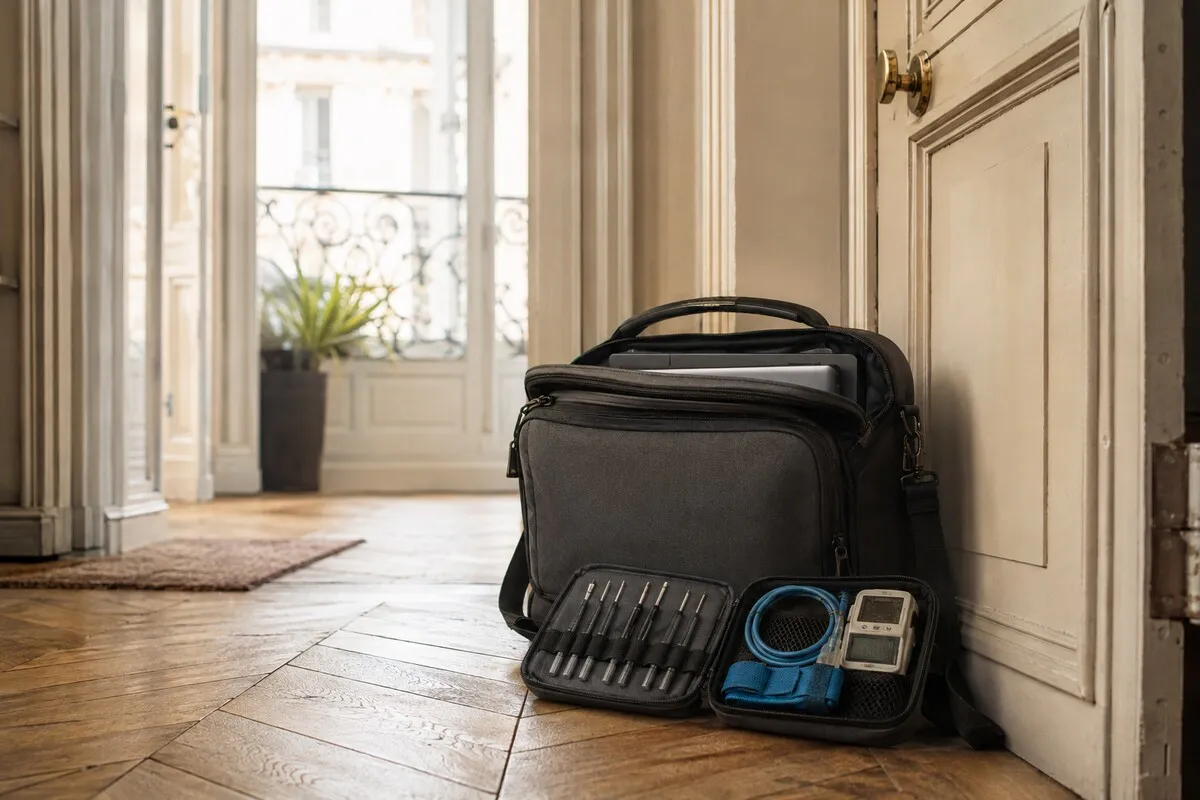
I work solo. No team, no van full of spare parts, no phone switchboard rerouting to "the next available technician." When I give you a timeframe, it's mine, built around my actual schedule for the day — not a ten-person fleet that can absorb a surprise by reassigning someone else. A site that promises a guaranteed 2-hour SLA, 7 days a week, without ever mentioning who would actually be there to deliver it, is selling fiction — one of the signs worth watching for when you're trying to find a good IT technician — and usually charging more for that fiction. An honest range also protects you as the client: if I say "between 2pm and 4pm" rather than a fixed time, you know it might slip by twenty minutes without that being a lie, rather than me inventing a number just to get off the phone faster.
What you can do to speed things up
Half the timeline of a repair is decided before I even arrive, during the phone or WhatsApp exchange. Four concrete things make a real difference. First, send a photo of the error screen or the visible problem: a vague message like "my computer isn't working" forces me to ask five follow-up questions by text before I know whether it's software, a power fault, or a cracked screen, while a photo often settles it in ten seconds. Second, give the exact model — not just "a MacBook" but "MacBook Pro 14-inch 2023" or the reference printed under the device — so I can check straight away whether I have the part in stock before I even set off. Third, share your real availability windows in the first message instead of a vague "whenever suits you": it saves three back-and-forth messages that could have booked the appointment in one. Finally, if the device still boots, back up what matters — photos, documents, contacts — before I arrive. That's not about saving time on the repair itself; it's about making sure a secondary problem discovered during diagnosis doesn't turn a simple repair into a data-recovery emergency.

Remote support: often the fastest path
For anything software-related — a sluggish Windows machine, a mis-set-up mailbox, a printer that won't install, a virus to remove — remote support is consistently the shortest route between the problem and the fix. No traffic to deal with, no travel slot to schedule around, no call-out fee to bill. I connect while you watch the screen, you see exactly what's happening, and the session ends when the problem is solved. It's obviously not an option for a cracked screen or a hardware fault, but for everything else, it's the closest thing to an immediate response I can honestly offer.
How I actually prioritise emergencies
Without a team, choices have to be made, and I use a simple rule: whatever is genuinely stopping someone right now goes ahead of what can wait. A billing server down on a Tuesday morning for a small business in the 8th takes priority over a slow personal laptop that's annoying but not blocking work. A call on a Sunday evening about something that can clearly wait until Monday gets a reply on Monday, not an emergency visit billed as one. That's not indifference or a lack of responsiveness — it's the only honest way to run a one-person schedule without either promising timeframes I can't keep, or billing everyone as an emergency to make up for it.
FAQ
Can an IT technician in Paris really come the same day?
Often yes for a simple call-out if you book in the morning, but it is not guaranteed: it depends on the arrondissement, traffic, and how many appointments are already booked that day. Next morning is a more reliable estimate.
Why not just promise a fixed response time, like 2 hours?
Because that would be a marketing lie. A solo independent technician cannot guarantee a fixed slot without knowing whether the part is in stock, where he currently is, or whether a more urgent case came in just before yours.
Is remote support really faster than an on-site visit?
For most software issues, yes, by a wide margin: a remote session usually starts within the hour, with no travel slot to wait for and no call-out fee to pay.
What if my computer breaks on a Friday evening?
Send a message with a photo of the error and the device model. I typically reply that evening or Saturday morning to work out whether it can wait until Monday or whether an express repair is justified.